At NiD4OCEAN, nature-inclusive designs (NiDs) are central to our mission. In our work, we understand NiDs as:
“Any intentional measure that creates optimised artificial habitat with the aim of enhancing selected biodiversity assets.”
— EU project ULTFARMS Glossary (see Cornacchia et al. 2025 for details)
In simple terms, NiDs are structures or features we intentionally design or add to certain infrastructure, like underwater cables or wind turbines, to create artificial habitats that promote the survival and growth of selected plants or animals.
NiDs can serve different ecological purposes1, and they typically fall into two main types:
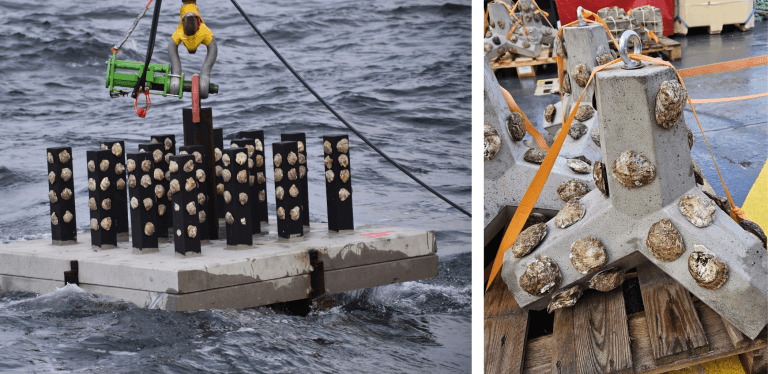
Designed to bring back ecosystem features that have been lost or degraded. These measures support the recovery of species or habitats in places where they naturally occur.
For example: Deploying oyster restoration cages which encourage distribution and settlement of the native oyster in an area previously depleted of them.
Creative NiDs
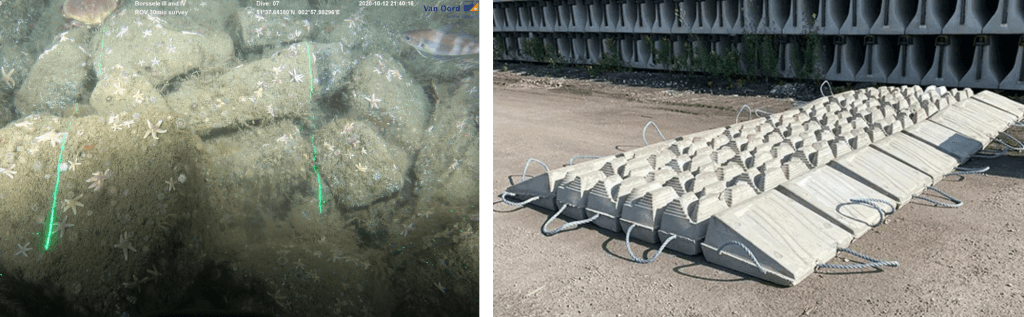
Aimed at enhancing biodiversity beyond what would naturally be found in the area. These measures introduce new habitat opportunities using artificial structures aimed at target species.
For example: Adding complex 3D structures around turbine bases in sandy or gravelly areas, turning soft sediments into different habitats for marine life.
Nature-inclusive designs can contribute to tackling some of the negative impacts that offshore renewable energy projects have on marine ecosystems. However, it is important to emphasise that they only come after the major impacts have been avoided and minimised through other measures. In other words, NiDs are implemented as part of the final steps in a structured mitigation approach to support biodiversity where ecological needs are clearly identified.
The rapid expansion of offshore renewable energy, particularly wind farms, can pose risks to coastal and marine ecosystems, and may challenge efforts to conserve and restore biodiversity. A recent ICES report, prepared for the European Commission (EC, DG MARE), highlights the economic, social, ecological, and cumulative impacts that bottom-fixed and floating wind farms can have on fisheries and marine ecosystems3.
Balancing the expansion of offshore energy with environmentally and socially sustainable practices is crucial. Offshore projects should preferably follow a structured approach, starting with careful marine spatial planning that considers economic, social, and ecological feasibility. Many countries worldwide have now adopted the mitigation hierarchy, a stepwise strategy to manage potential ecological impacts effectively.
This hierarchy beings by predicting the impacts that may occur during all project phases, including pre-construction, construction, operation, and decommissioning. It then moves through avoidance, minimisation, and restoration. This final step can include NiDs as part of the mitigation measures. If impacts remain after these steps, offsetting measures are applied to compensate for ecological and socio-environmental effects.

NiDs are considered the last step in this hierarchy. At NiD4OCEAN, we see this sequence as essential: it ensures that NiDs are implemented only when clearly justified and based on identified ecological needs. Our research focuses on NiDs and related mitigation measures, particularly design modifications, which we collectively refer to as nature-inclusive concepts.
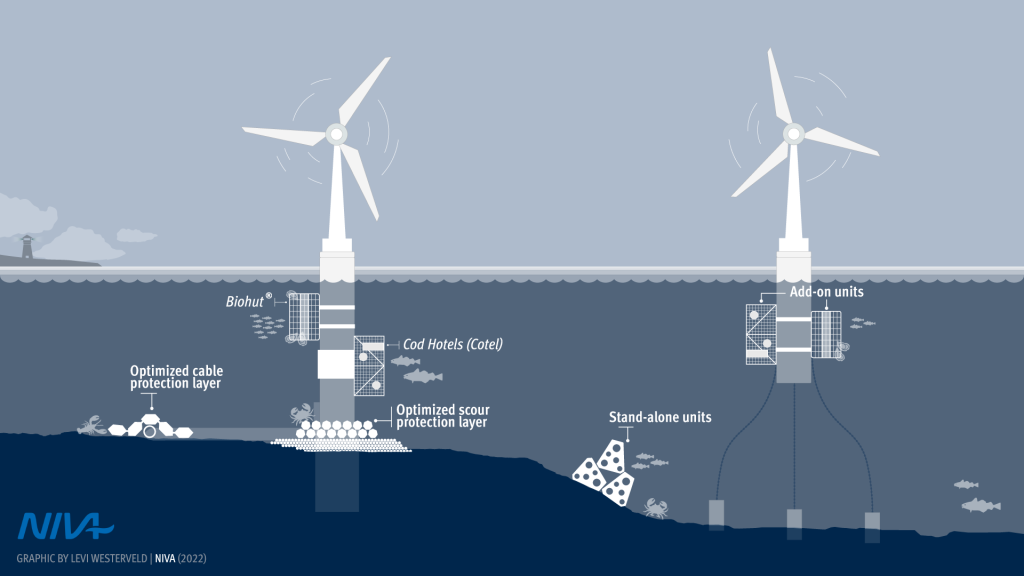
Nature-inclusive designs can be integrated into existing or planned infrastructure where they can provide ecological benefits. In practice, NiDs are set around turbine foundations and cables, either as optimising existing structures (such as cable protections) or as stand-alone units.
Existing underwater NiD concepts can be broadly grouped into four types: optimised scour protection layers, optimised cable protection layers, add-on options, and stand-alone solutions. All of these aim to enhance ecological function2.
Literature to cite:
1.Cornacchia, L.,Degraer, S., van Duren, L., Petersen, J. K., Ziemba, A., van Gerven, A., Declercq, A., Bolman, B., Huijben, E., Strothotte, E., El Serafy, G., van de Braak, K., Poelman, M., Hughes, M., Bos, O., Kamermans, P., van den Burg, S., Patel, T., Selnes, T., Staufenberger, T., Maguire, J., Nimz, J., Becker, J., Stratigaki, V., Moulaert, I., Stojanovic, I. (2025). ULTFARMS NID Glossary (v1 – April 2025) – Glossary of terms and common definitions related to Nature-inclusive Design. Zenodo. https://doi.org/10.5281/zenodo.15149198
2.Hermans, A., Bos, O.G. andPrusina, I., 2020. Nature-Inclusive Design: A catalogue for offshore wind infrastructure: Technical report (No. 114266/20-004.274). Witteveen+ Bos.
3.ICES. 2025. Workshop to compile evidence on the impacts of offshore renewable energy on fisheries and marine ecosystems (WKCOMPORE). ICES Scientific Reports. 7:45. 283 pp. https://doi.org/10.17895/ices.pub.28759259
4.Pardo, J.C.F., Aune, M., Harman, C.,Walday, M. and Skjellum, S.F., 2023. A synthesis review of nature positive approaches and coexistence in the offshore wind industry. ICES Journal of Marine Science, p.fsad191.