Offshore renewable infrastructure must be developed in a way that does not harm the marine environment, and where possible, contributes to European restoration goals. Recent years have seen an increase in measures aimed at mitigating negative effects of infrastructure development (i.e. mitigation measures) or enhancement or restoration of certain habitats (i.e. nature-inclusive designs). These concepts have been tested mainly in bottom-fixed offshore wind farms, but there is a lack of solutions for floating offshore wind infrastructure.
In this Open Challenge, we seek innovative nature-inclusive concepts tailored to floating offshore wind infrastructure. We look for concepts to be implemented within offshore wind farms or the related infrastructure (e.g. connecting grid, subsea platforms) targeting:
To win the Open Challenge applicants will have to ensure their concept addresses one or more ecological issues related to floating offshore wind infrastructures within the context of European sea basins, and are structurally sound, scalable and cost-effective. Applicants succeeding in addressing these factors will receive an exclusive price:
In this Open Challenge, we seek innovative nature-inclusive concepts tailored to floating offshore wind infrastructure. We look for concepts to be implemented within offshore wind farms or the related infrastructure (e.g. connecting grid, subsea platforms) targeting:
We invite innovators to think outside the box and propose concepts that address one or more of these challenges, including solutions at a very early stage of development (Technology Readiness Level, TRL1-2).
Proposed concepts must address one or more ecological issues related to floating offshore wind infrastructures, within the context of European sea basins.

All submitted proposals will receive feedback from a multi-disciplinary expert panel composed of relevant NiD4OCEAN partners to improve technical design and/or business case, including developers, contractors and research institutes.
The winning concept will be upscaled up to TRL4 (technology validated under laboratory conditions) at Deltares (Netherlands). Please refer to details here concerning Deltares hydrodynamic, geotechnical and biological, chemical and physical research facilities.
The 3-5 top ranked concepts will be invited to a showcase side event organised in the WindEurope’s Annual Event 2026 in Madrid, attended by over 500+ organisations from across the entire wind energy value chain such as wind associations, financial and research institutions, environmental organisations, and policy makers at both the EU and member state level.
This challenge is open to:
Proposal application, evaluation and selection is a two-stage process. Stage 1 will require the submission of a short application (pdf format) by e-mail to [email protected] by September 1st 2025 (23:59 Central European Time). Eligible proposals will be reviewed by a multidisciplinary expert panel who will provide feedback to applicants on how to improve their proposed concept. Eligible applicants will be then invited to submit a full proposal (ca. 5 pages) to the same email address by November 2nd 2025. Timeline for the application and evaluation process is as follows:
Applicants are encouraged to read and download all relevant files before proceeding with the submission.
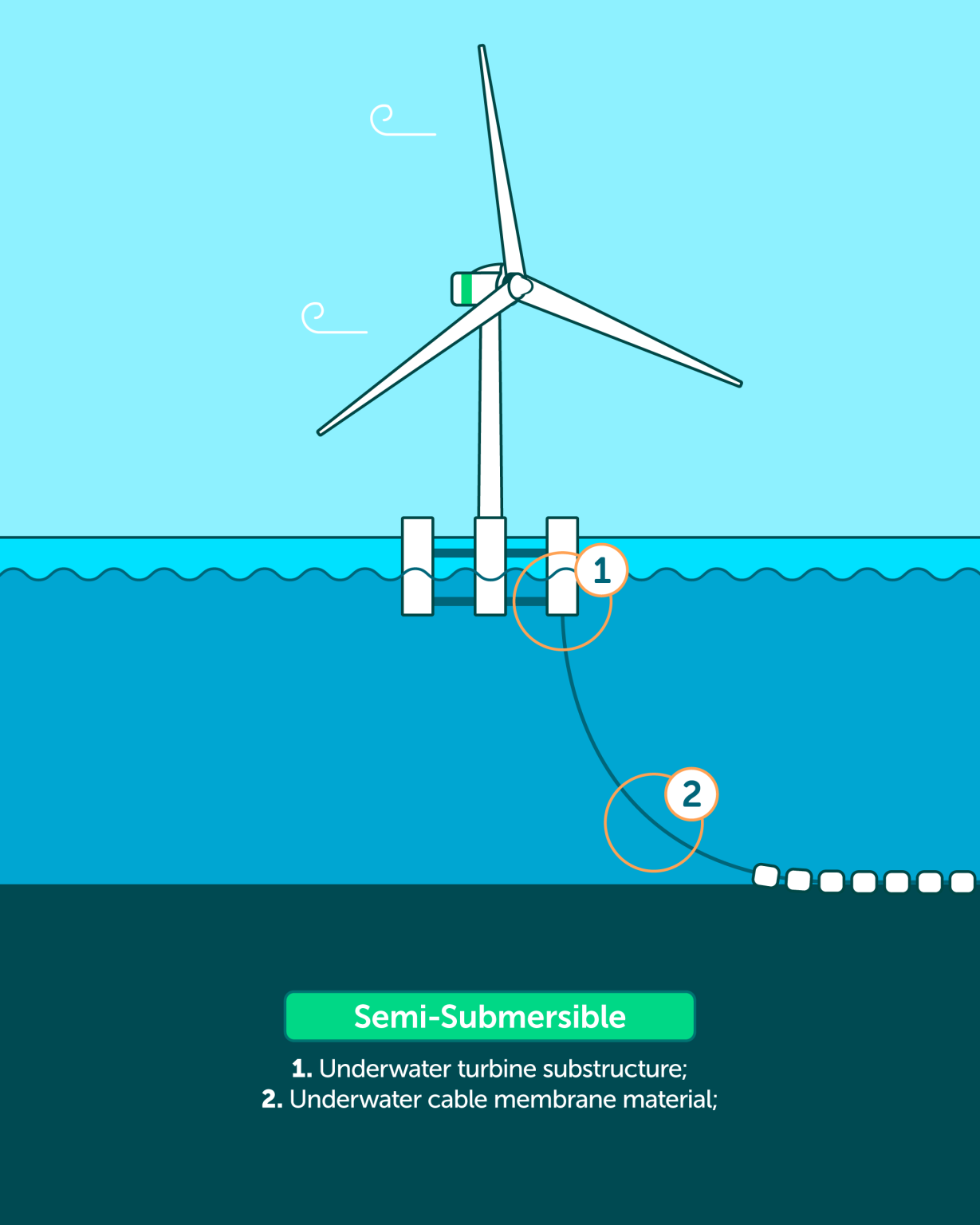
Below are some general specifications about floating wind infrastructures:
In recent years, there has been a considerable increase in mitigation measures and nature-inclusive designs for bottom-fixed offshore wind infrastructure [1,2,3,4,5], including measures associated with underwater noise, disturbance and displacement, and solutions designed to optimise scour protection and cable protection layers, add-on structures and stand-alone units [6,7,8].
However, there is a reduced number of available solutions specifically for floating offshore wind infrastructures. Floating offshore wind farms are fundamentally different from bottom-fixed turbines, as they are placed in deeper waters (>50 m depth), further from shore using floating structures anchored to the seabed by mooring lines or chains (see section “Additional information about floating wind structures” below). As such, they are expected to have different impacts on local marine ecosystems compared to bottom-fixed (e.g. wildlife entanglement, continuous chain dragging of the seabed, anchor’s impacts), but might also offer new opportunities for nature enhancement and the ecosystem restoration when placed in degraded habitats. These aspects are particularly relevant given the ambitious goals towards net-positive biodiversity that offshore wind developers are targeting, which will require context-dependent options. Therefore, it is critical to apply the lessons learned from bottom-fixed infrastructure, develop solutions targeting this technology, and ensure that novel nature-inclusive concepts are ecologically relevant, feasible, and scalable.
This Open Challenge is organised in the frame of the Horizon Europe project NiD4OCEAN (Nature-inclusive Designs for reconciling offshore renewables with ocean protection). The overall goal of the project is to advance the emerging field of nature-inclusive designs for offshore renewables, and provide effective, context-dependent solutions to industry, managers, and policy makers, to support of the global and EU targets for carbon neutrality, biodiversity restoration and sustainable and inclusive ocean economy. In the context of the NiD4OCEAN project, we are organising an Innovation Challenge series, including an Open Challenge for SMEs, start-ups, and the winners of the University Innovation challenges targeting University students.
[1] Galparsoro et al. (2022) Reviewing the ecological impacts of offshore wind farms. npj Ocean Sustain 1:1
[2] Lemasson et al. (2024). A global meta-analysis of ecological effects from offshore marine artificial structures. Nature Sustainability, 7(4), 485-495
[3] Watson et al. (2024). The global impact of offshore wind farms on ecosystem services. Ocean & Coastal Management, 249, 107023
[4] link to NiD4OCEAN website: what are NiDs
[5] Ocean – Offshore Coalition for Energy and Nature (2024) Avoidance and minimisation from offshore wind and grid infrastructure
[6] Hermans et al. (2020) Nature-Inclusive Design: A Catalogue for Offshore Wind Infrastructure. The Hague: Witteveen+Bos 50pp.
[7] Pardo et al. (2023) A synthesis review of nature positive approaches and coexistence in the offshore wind industry. ICES Journal of Marine Science, fsad191
[8] The Toolbox. Rich North Sea. Website.
Will submissions remain confidential between the selection committee and the applicant?
All submissions will only be visible by the applicant and the selection committee. All submissions will remain confidential.
Is there a definition of eligible companies?
No, we are open to receiving submissions from companies of all sizes.
Can one company submit more than one proposal?
Yes, you can submit more than one proposal. Note they will need to be submitted separately and be independent.
Can consortia (i.e. different institutions) apply for the challenge?
Yes
Can the same applicant submit different concepts under different TRLs?
Yes.
Which institutions and expertise will be represented at the expert panel?
The expert panel will be constituted by members of the NiD4OCEAN consortium including developers, contractors and research institutes, spanning an expertise from marine ecology and structural engineering to offshore wind park development, construction and maintenance. NiD4OCEAN involves 13 partners including Norwegian Institute of Water Research (NIVA), Akvaplan-NIVA, Wageningen Research, Deltares, Spanish National Council (CSIC), Danish Technical University (DTU), University of Klaipéda, North Sea Foundation, Renewables Grid Initiative, Science Crunchers, DNV, ScottishPower Renewables, and Equinor.
Will the NiD4OCEAN expert teams support the design and engineering aspects of the winning concept, and is there any financial contribution for the testing?
To a certain extent, yes. Support will be provided through feedback sessions, component down-scaling, layout support, access to operating facilities, and assistance with measurements, and potential model construction depending on the concept, measurement requirements.
Can we select the research facilities to be used?
The catalogue of available facilities is listed on the Deltares website. We urge you to already in application phase indicate which facility or type of facilities would be required for testing your innovation. However, the final selection of the facility will be discussed and agreed upon in collaboration during Stage 2 of the process, based on suitability, optimal resource management and finally availability of the facility and personnel which will be a leading deciding factor.
Is there a possibility to scale the testing to higher TRLs?
Not within the scope of NiD4OCEAN, but the consortia have the capacity to support such scaling through other means.
Would NiD4OCAEN partners also provide engineering support?
The consortium will support only through feedback sessions, not through desk assessments, modelling, or direct engineering work.