To build a sustainable future where offshore renewables and ocean protection go hand-in-hand, at the NiD4OCEAN project we are committed to advancing the field of nature-inclusive designs (NiDs). Our ambition is to support the transition towards a sustainable blue economy, by providing science-based tailored solutions to industry, managers, and policymakers.
Build a strong knowledge base for the emerging field of nature-inclusive designs by mapping current solutions and creating new ones for offshore renewable energy across European seas.
Explore the benefits and risks of these designs by developing tools to measure their impact on the environment, economy, and livelihood of coastal communities at various stages and scales.
Provide guidelines for choosing, implementing, and monitoring these designs with input from industry and policymakers, and tailor them to specific regions, ecosystems, and technologies.
Increase awareness about the importance of balancing biodiversity and decarbonisation through engagement and strategies aimed at all users of the sea.
Running for 36 months, NiD4OCEAN is divided into six work packages
Lead: NIVA
Objectives: a) To ensure effective work plan implementation and manage the project in line with the Grant Agreement (GA) and Consortium Agreement (CA). b) To facilitate efficient communication within the consortium and assure effective reporting and transfer of information to the European Commission (EC). c) To manage scientific data and ethics in accordance with the highest EU standards
WP Leader/Lead: CSIC
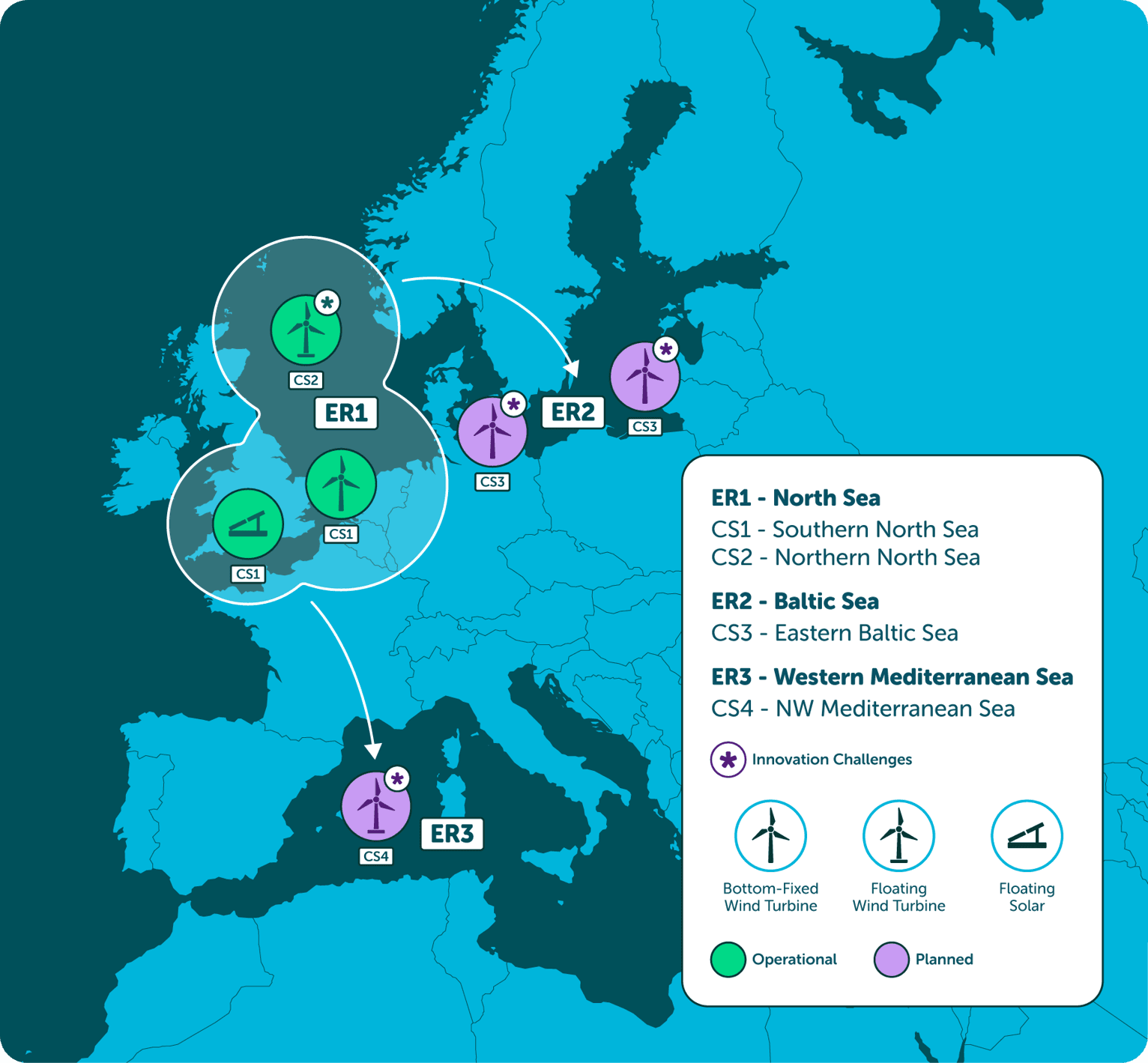
Objectives: a) Map existing NiDs for offshore renewables, focusing on offshore wind, and compile a catalogue considering the specific technological and ecological context from each of the studied regions (Mediterranean, North Sea, Baltic Sea). b) Review the environmental and socio-economic impacts, and the socio-political dimensions associated to NiDs for OWF across their life cycle stages in the three study ecoregions to define assessment metrics. c) Provide a framework and a protocol to assess the effects of NiDs in each study region, with particular emphasis on (i) vulnerable and policy-relevant species and habitats in the frame of EU Directives (Birds and Habitats Directives) and international conventions for the protection of the flora and fauna, and (ii) marine protected areas (Natura 2000 sites and other types of MPAs). Overall, WP2 will contribute to establishing an Accountability Framework as a practical roadmap for addressing the ecological, socio-economic, and sociopolitical challenges of the use of NiDs in OWF.
Lead: WR /NIVA
Objectives: a) Identify gaps and provide future directions for novel NiDs, particularly for emerging technologies (e.g., floating offshore turbines, floating solar). b) Establish an innovation challenge series within the NiD4OCEAN network to develop novel NiDs for offshore renewables and raise awareness on the need for these solutions. c) Prototype and test 1-2 novel NiDs for moorings in floating wind turbines under realistic laboratory conditions (bring concept to TRL 4).
Lead: Deltares
Objectives: To design new science-based tools to support the impact evaluation of Nature Inclusive design measures at different scales. This includes a) Review existing methods and tools to assess NiD-goals and identify gaps. b) Co-develop models to assess effectivity of NiD measures to achieve set goals, addressing local scales as well as ecosystem scales. c) Apply the tools to identified demonstration sites and test their transferability to other systems.
Lead: DTU-Aqua
Objectives: a) WP5 will deliver co-designed industry-facing decision-support tools to aid NiD selection and help ensure their uptake. b) WP5 will introduce recommendations for NiD standards to be integrated intotechnical qualifications to increase clarity on NiDs most suited to different regions and ecological contexts. Finally, c) WP5 will provide policy clarity on the conditions in which OWF can not only co-exist with biodiversity restoration endeavours in their neighbourhoods but also contribute to them. It will provide recommendations, particularly on conditions under which NiDs at OWF can be considered for helping connect the Natura 2000 MPA network.
Lead: RGI/Science Crunchers
Objectives: a) To develop a robust visual identity for the project and effectively communicate and disseminate project results to pertinent audiences across Europe and beyond. b) To promote the adoption of novel NID solutions developed and tested during the project among relevant stakeholders in the three sea basins covered by the consortium with the support of a Decision Support Tool. c) To ensure that the outcomes of the project and the ground-breaking NID solutions will be widely disseminated, communicated, and leveraged even beyond the project’s duration through a comprehensive communication strategy, user-friendly products, event organisation, and outreach activities.
Our communication activities within the NiD4OCEAN project will focus on the following key messages
The rapid growth of offshore renewable energy infrastructure required to meet Europe’s decarbonisation targets has raised concerns about potential conflicts with biodiversity conservation and restoration goals. It has been proposed that, by integrating nature-inclusive designs (NID), offshore renewable infrastructure could potentially play a dual role — delivering energy with lower carbon emissions while contributing to restoring degraded ecosystems. Gaining a better understanding of how NiD function and perform is key to setting realistic expectations for the role offshore renewable infrastructure can play. This represents a first step towards the development of best practices and standards for the effective implementation of NiD. Importantly, NIDs do not substitute sound Maritime Spatial Planning, which remains the primary tool for identifying areas suitable for offshore wind development that avoid harm to vulnerable species and sensitive habitats. Rather NiD should complement avoidance and mitigation measures, as well as more conscious infrastructure design.
Nature-inclusive design (NiD) can offer new possibilities for enhancing selected biodiversity assets (species, functions, processes) within offshore renewables infrastructure. However, significant knowledge gaps remain regarding the use of NiD across European seas. Addressing these gaps and clarifying what NiD are, where they are the most effective, and how to measure their effectiveness is crucial for delivering robust, evidence-based scientific recommendations and decision-support tools. Using a transdisciplinary approach to synthesise and share knowledge on NiD can foster the development and co-creation of novel concepts, as well as explore the transferability of existing solutions to different ecoregions.
The development of offshore renewables must be conducted responsibly, accounting for both nature and people. Raising awareness among different stakeholders on the need to simultaneously meet both decarbonisation and biodiversity targets will help support a just and sustainable energy transition. Collaborating with local communities, industry representatives, environmental NGOs, and other relevant stakeholders is crucial for co-developing policy recommendations and standards. These guidelines will inform in which cases and at what stage it is appropriate (or not) to recommend nature-inclusive designs based on the environmental and socio-economic context of each offshore renewable energy project, thereby reducing uncertainty for the end user and avoiding conflicts with other users of the sea.